
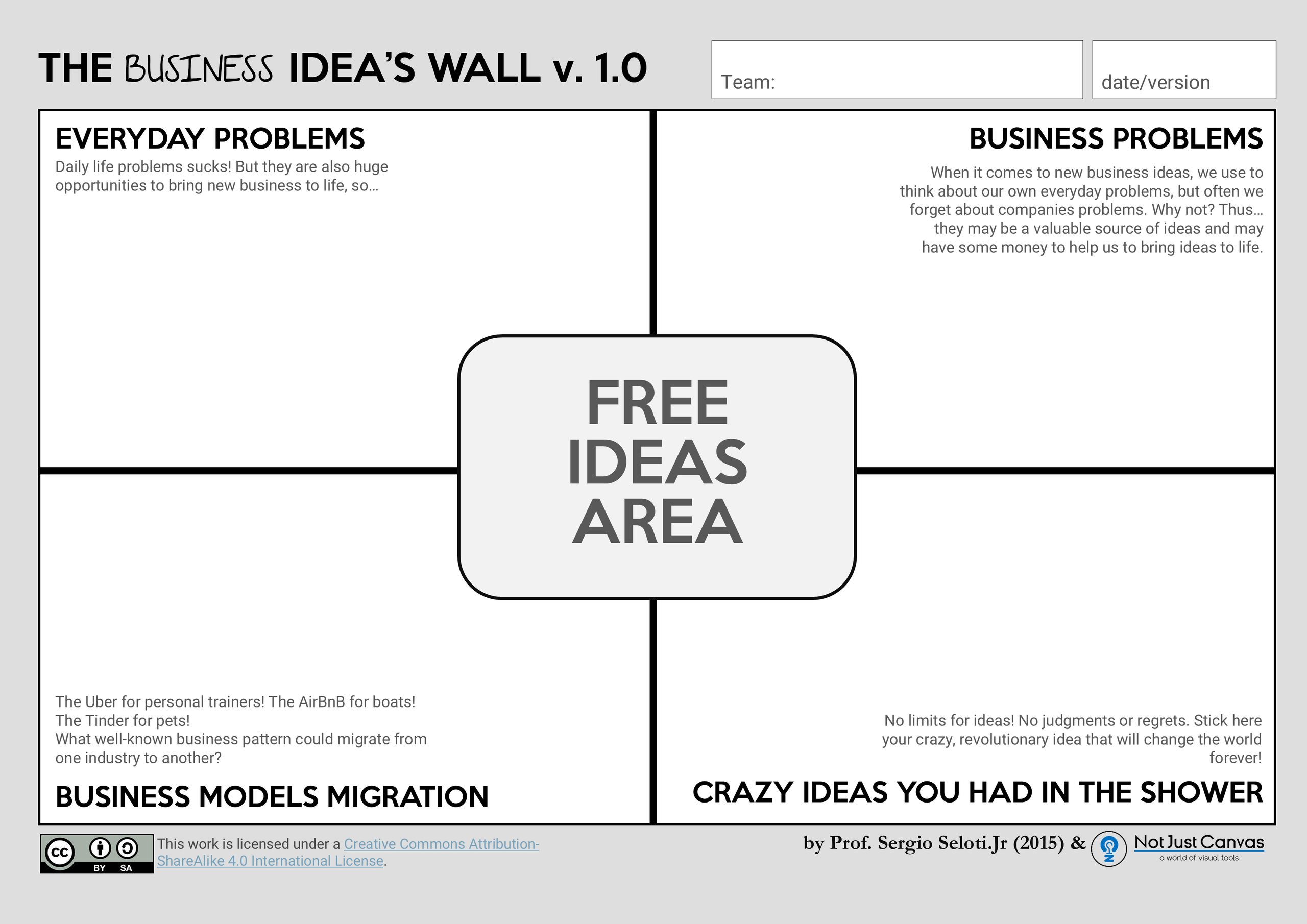
Everyday frustrations, business problems, borrowed business models, and those crazy ideas you had in the shower. What do they have in common? They might become your next business.
Tool designer: Sergio Seloti.Jr
First publication year: 2015
Creative Commons: Attribution-ShareAlike 4.0 International License
We’ve all been there.
You’re taking a shower, driving to work, having dinner with friends, or simply dealing with some annoying everyday situation when suddenly an idea pops into your head.
What if there was a business that could do this?
For a few seconds, it seems brilliant. Perhaps even revolutionary.
You start imagining how it could work, who would use it, and how much money it could make.
And then, usually, one of two things happens.
You forget about it.
Or you tell someone, who immediately explains why it would never work.
Sounds familiar?
The funny thing about business ideas is that they can come from almost anywhere. Some are born from serious problems, others from unexpected connections between industries, and quite a few from situations that initially seem completely ridiculous.
But when we sit down in a meeting room and someone says, “OK, let’s come up with some innovative business ideas,” suddenly creativity becomes surprisingly difficult.
So, what if we had a simple way to stimulate, organize, and explore different sources of business ideas?
That’s the idea behind The Business Idea’s Wall.
Business ideas don’t always start with a brilliant insight
There is a popular image of the entrepreneur who suddenly experiences a moment of genius.
An extraordinary idea appears out of nowhere, and everything else follows.
It makes a great story.
But the reality of business ideation is usually less glamorous.
Many interesting business opportunities emerge from observing something that doesn’t work particularly well, identifying an unmet need, or recognizing that an existing business approach could be useful in a completely different context.
Sometimes, the idea itself is not particularly new.
What is new is where, how, or for whom it is applied.
And sometimes, of course, the idea really is something unusual that nobody has seriously considered before.
This diversity of origins is precisely why I don’t believe there should be only one way to generate business ideas.
If you always start by asking people to identify customer problems, you might miss opportunities based on business model innovation.
If you only look for technological breakthroughs, you may overlook perfectly ordinary problems that affect millions of people.
And if every idea must sound immediately feasible, you’ll probably eliminate some interesting possibilities before anyone has had the opportunity to explore them.
Different kinds of ideas require different starting points.
The Business Idea’s Wall was created around this relatively simple principle.
Meet The Business Idea’s Wall
The Business Idea’s Wall is a visual ideation tool designed to help individuals and teams generate and organize business ideas from different perspectives.
The canvas is divided into four areas surrounding a central Free Ideas Area.
Each area represents a different source of inspiration:
- Everyday Problems
- Business Problems
- Business Models Migration
- Crazy Ideas You Had in the Shower
Notice that these are not stages of a process.
You don’t need to start with everyday problems, move to business problems, and finish with crazy ideas.
You can explore any area, move between them, combine ideas, or use the central space for something that doesn’t fit anywhere else.
The objective is not to produce a perfectly structured business model.
At this point, the objective is to generate possibilities.
Let’s explore where they might come from.
Everyday Problems: There must be a better way!
Think about your typical day.
How many things annoy you?
Perhaps you spend too much time trying to schedule an appointment. Perhaps a service you depend on is unnecessarily complicated. Maybe something at home breaks, and finding someone reliable to repair it becomes a project in itself.
Or perhaps you’ve noticed a recurring inconvenience that everyone around you seems to have accepted as normal.
Now, ask yourself:
Why does it have to be this way?
Many business ideas begin with exactly this question.
Everyday problems are particularly interesting because we experience them directly. We know how frustrating they can be, how frequently they occur, and sometimes even how much time or money we spend dealing with them.
For example, imagine noticing that people in your neighborhood struggle to find trustworthy professionals for small household repairs.
Could there be an opportunity for a specialized service that connects homeowners with qualified professionals?
Perhaps.
Or imagine realizing that families regularly struggle to coordinate transportation for children’s activities.
Could there be a business opportunity there?
Again, perhaps.
At this stage, you don’t need to know precisely how the business would work.
Simply collect the problems and the ideas they inspire.
But be careful with one important assumption.
Just because something annoys you doesn’t mean that everyone else considers it a problem worth paying to solve.
That’s something to investigate later.
For now, however, everyday frustrations are a remarkably accessible source of business inspiration.
You just need to start paying attention.
Business Problems: Companies have problems too!
When people are invited to think about new business ideas, they often focus on products and services for individual consumers.
Apps, marketplaces, delivery services, personal services, and other consumer-facing businesses tend to dominate the conversation.
But there’s another enormous universe of opportunities out there.
Companies.
Businesses experience problems every day.
They struggle with inefficient processes, unreliable suppliers, poor information, operational complexity, employee turnover, expensive technologies, changing regulations, and countless other challenges.
Some of these problems may be invisible to ordinary consumers.
Yet, for the companies experiencing them, they can be extremely important.
And here’s something worth remembering:
Companies may have budgets specifically allocated to solving their problems.
Consider a small manufacturing company struggling to coordinate production schedules with suppliers.
Or a consulting firm spending considerable time preparing reports manually.
Or a restaurant chain having difficulty maintaining consistent quality across different locations.
These situations may create opportunities for new services, products, technologies, or business models.
The challenge, of course, is understanding what is really happening inside those organizations.
Unlike everyday consumer problems, business problems may require industry knowledge, observation, interviews, or direct experience.
But they can also reveal valuable opportunities that might never emerge from a conventional consumer-focused brainstorming session.
So, when looking for business ideas, don’t ask only:
What problems do people have?
Also ask:
What problems do companies have?
You might be surprised by what you discover.
Business Models Migration: What if we borrowed an idea?
This is another particularly interesting source of innovation.
Sometimes, you don’t need to invent a completely new business model.
You just need to recognize that an existing approach might work somewhere else.
Think about the business models that became widely recognizable through companies such as Uber, Airbnb, or Tinder.
They introduced or popularized patterns that people can recognize beyond their original applications.
Now imagine applying similar principles to other industries.
The Uber for personal trainers!
The Airbnb for boats!
The Tinder for pets!
These are deliberately provocative examples included in the original Business Idea’s Wall.
Are they all good business ideas?
Not necessarily.
But that’s not the point.
The point is to challenge yourself to recognize business model patterns that might migrate from one industry to another.
For example, what would happen if a subscription model commonly used for digital services were applied to a traditional maintenance business?
Could an equipment-sharing model work in an industry where expensive assets remain unused for much of the time?
Could an on-demand service approach create value in a market dominated by long-term contracts?
These questions encourage a different kind of creative thinking.
Instead of asking, “What completely new business can we invent?”, we ask:
What already works somewhere else, and what would happen if we applied it here?
Of course, copying a familiar business model does not guarantee success.
Different industries have different economics, customer behaviors, regulations, and operational requirements.
The “Uber for X” formula can be an excellent creative trigger and a terrible substitute for actual business design.
But at the ideation stage, analogies can open doors that might otherwise remain closed.
Sometimes, innovation is less about inventing new pieces and more about putting existing pieces together in an unexpected way.
Crazy Ideas You Had in the Shower: Why not?
Now we get to my favorite kind of creative freedom.
You know those ideas that sound so unusual that you hesitate before telling anyone?
The ones that come to mind while taking a shower, walking the dog, or staring out of the window?
Well, they deserve a place too.
This area of the Business Idea’s Wall is deliberately called Crazy Ideas You Had in the Shower.
The instruction is simple:
No limits for ideas! No judgments or regrets.
Imagine a service that rents out fully equipped miniature offices in people’s gardens.
Or a restaurant where customers design the menu together with the chef using ingredients available that day.
Or a platform where retired professionals offer short, highly specialized problem-solving sessions to small companies.
Would any of these become a successful business?
Who knows?
Some may be impractical. Others may be technically possible but economically unviable. And a few might contain the beginning of something interesting.
What matters here is allowing ideas to emerge without immediately demanding that they justify their existence.
In structured innovation environments, people can become remarkably efficient at rejecting new ideas.
Someone raises a possibility, and another person immediately starts explaining the difficulties.
Too expensive.
Too complicated.
Someone has already tried that.
Customers would never pay for it.
Regulations wouldn’t allow it.
Perhaps these objections are correct.
But there is a time for evaluating ideas and a time for generating them.
And confusing those two moments can seriously undermine creativity.
An unusual idea doesn’t need to be viable to be worth exploring. Sometimes, its greatest value lies in the different possibilities it helps us imagine.
So, give those shower ideas some space.
You can challenge them later.
The Free Ideas Area: Because ideas don’t respect categories
At the center of the canvas is the Free Ideas Area.
Why?
Because not every idea fits neatly into a predetermined category.
Perhaps someone proposes something that combines an everyday problem with a business model borrowed from another industry.
Perhaps an idea emerges from a technological development rather than a specific problem.
Or perhaps a discussion between team members produces an unexpected concept that doesn’t belong to any of the four surrounding areas.
That’s perfectly fine.
The central area provides room for these possibilities.
It can also become a place to bring together ideas originating from different parts of the wall.
Imagine combining an everyday problem related to childcare logistics with a business model inspired by shared mobility.
Or taking an operational problem experienced by small companies and approaching it through a subscription-based service model.
The individual ideas may not be particularly original.
But their combination might be.
In fact, some of the most interesting moments in an ideation workshop happen when people begin connecting contributions that initially seemed unrelated.
And that’s one of the advantages of making ideas visible on a shared wall.
Instead of keeping them isolated in individual notebooks, they become available for everyone to examine, question, extend, and combine.
How to use The Business Idea’s Wall
The tool can be used individually, but it is particularly suitable for collaborative ideation sessions.
Start by placing the canvas somewhere visible, whether on a physical wall or in a digital collaborative workspace.
Invite participants to contribute ideas using sticky notes or their digital equivalent.
You may introduce the four areas one at a time, using the questions in each section as creative prompts.
Or you may allow people to explore them freely.
I would suggest beginning with a relatively short individual ideation period before opening the discussion to the group.
Why?
Because group discussions can sometimes become dominated by the first few ideas presented or by the most outspoken participants.
Giving everyone some time to think independently can help increase the diversity of contributions.
Then, bring the ideas together.
Encourage participants to read what others have proposed, build on existing ideas, and look for unexpected connections.
Resist the temptation to evaluate everything immediately.
At this stage, a ridiculous idea can be just as useful as a sensible one if it leads to an interesting conversation or inspires a better alternative.
Once you’ve generated a reasonable collection of possibilities, you can begin exploring them more critically.
Which ideas address meaningful problems?
Which are particularly interesting or unexpected?
Which might deserve further investigation?
Which combinations create something different?
You don’t necessarily need to select a winner immediately.
Sometimes, the best outcome of an ideation workshop is a shortlist of promising ideas that deserve to be developed.
And that’s where other tools can help.
From the Wall to a Business Idea Worth Exploring
There’s something important I should emphasize.
The Business Idea’s Wall is not a business model design tool.
Nor is it intended to validate market demand, demonstrate feasibility, or prove that a particular idea represents a genuine business opportunity.
Its purpose is earlier in the process.
It helps generate possibilities.
Once an idea emerges, there are several questions we still need to answer.
What problem does it solve?
Who experiences that problem?
How are people or organizations dealing with it today?
Why would the proposed solution be better than existing alternatives?
And, perhaps most importantly, would anyone actually want it?
These questions are central to another tool in the Not Just Canvas collection: The Business Idea Canvas.
While the Business Idea’s Wall encourages the generation of ideas from different perspectives, the Business Idea Canvas helps investigate the problems, stakeholders, existing alternatives, and proposed solutions behind them.
They serve different purposes and can complement each other.
For example, you might use the Business Idea’s Wall during an entrepreneurship workshop to generate a collection of ideas.
Then, select a few promising possibilities and explore them more deeply with the Business Idea Canvas.
Some will survive that investigation.
Others won’t.
And that’s perfectly fine.
A good ideation process should produce possibilities, not unconditional commitments.
The purpose of exploring an idea is not to prove that it is brilliant.
It is to discover whether it deserves further attention.
Last, but not least
One of the things I’ve learned from working with innovation and entrepreneurship is that creativity and critical thinking need each other.
But they don’t always work well when we demand both at precisely the same moment.
When generating ideas, excessive criticism can prevent interesting possibilities from emerging.
When evaluating ideas, excessive enthusiasm can make us ignore important problems.
The challenge is knowing when to encourage each approach.
The Business Idea’s Wall is deliberately positioned on the creative side of this relationship.
It invites you to look for opportunities in ordinary frustrations, organizational problems, familiar business models, and ideas that initially sound a little crazy.
And it gives those ideas a shared space where they can be explored and combined.
Does that mean every idea on the wall has the potential to become a successful business?
Of course not.
Some will be terrible.
Some will be interesting but impractical.
Some will lead nowhere.
And perhaps one or two will make you stop and think:
Wait a minute. What if we actually tried this?
That’s when things start getting interesting.
You don’t need every idea to be a good idea. You need to create the conditions in which good ideas have a chance to emerge.
And sometimes, all it takes is a wall, a few sticky notes, and the willingness to ask:
What if…?
To download The Business Idea’s Wall
You can use The Business Idea’s Wall v1.0, developed by Prof. Sergio Seloti.Jr (2015), to support brainstorming sessions, entrepreneurship workshops, innovation challenges, and early-stage business ideation.
Use it individually or collaboratively, and explore the possibilities that emerge before moving into more structured problem investigation and business design.
The Business Idea’s Wall is available under a Creative Commons Attribution-ShareAlike 4.0 International License.
Not Just Canvas — a world of visual tools.
Leave a Reply