
Are You Solving the Right Problem?
Before you start designing solutions, make sure you understand the problem worth solving.
How many times have you seen a team fall in love with a solution before truly understanding the problem?
“We need an app.”
“We should implement AI.”
“Our customers need a better experience.”
“We need to redesign our business model.”
These statements might sound like the beginning of an innovation project. But there’s something fundamentally wrong with them: they either describe a solution or express a vague ambition. None defines a problem.
And this is where many innovation initiatives go wrong.
We are often so eager to solve problems that we skip the uncomfortable work of understanding them. We jump into brainstorming sessions, generate dozens of ideas, build prototypes, and sometimes invest considerable resources in solutions to problems we never properly investigated.
The result? Beautiful solutions looking for problems to solve.
What if we reversed this logic?
Meet the Problem Statement Canvas
The Problem Statement Canvas, part of the Not Just Canvas collection of visual tools, is designed to help individuals and teams investigate, structure, and articulate problems before committing to solutions.
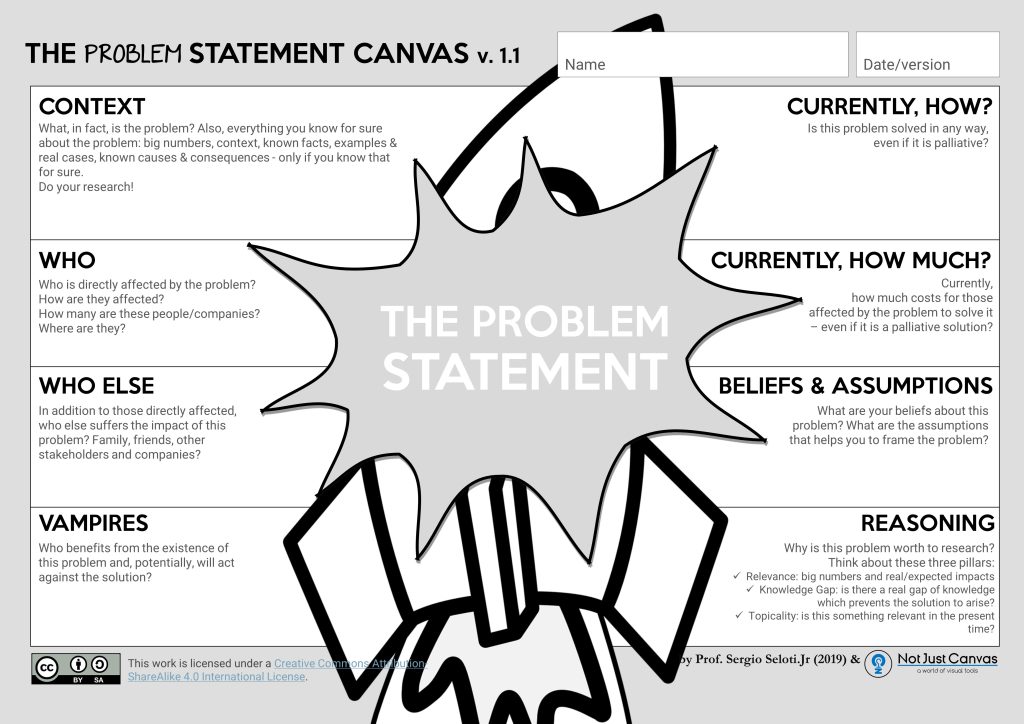
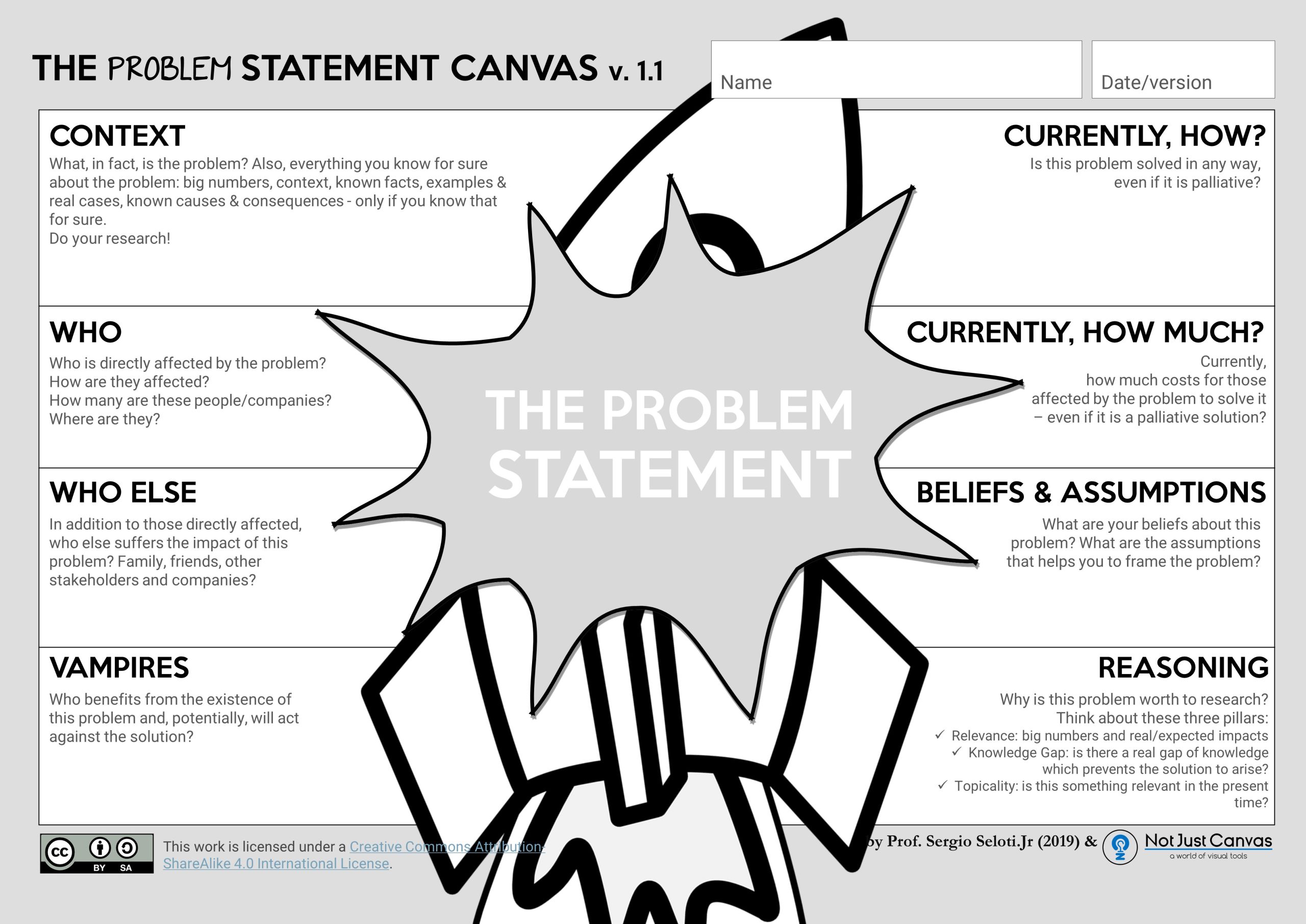
Rather than jumping straight into ideation, the canvas encourages a disciplined exploration of the problem from multiple perspectives.
At its center is the ultimate outcome: The Problem Statement.
Surrounding it are eight interconnected areas that help you understand not only what is happening, but who is affected, how the situation is currently managed, what it costs, which assumptions influence your interpretation, and why the problem deserves attention.
The eight areas are:
- Context
- Who
- Who Else
- Vampires
- Currently, How?
- Currently, How Much?
- Beliefs & Assumptions
- Reasoning
Each addresses a different aspect of the problem. Together, they create a much stronger foundation for innovation, entrepreneurship, research, and strategic decision-making.
Let’s explore them.
Context: What Is Actually Happening?
Start with the facts.
What, in fact, is the problem? What do you know about it? What evidence supports your understanding?
Consider its scale, background, known causes, consequences, relevant figures, examples, and documented cases.
The critical rule is simple: don’t confuse what you know with what you think you know.
Suppose someone tells you that employees are leaving a company because they are dissatisfied with management.
Is that a fact? Or an interpretation?
Perhaps exit interviews support that conclusion. Perhaps they don’t. Perhaps turnover is concentrated in certain departments, roles, or periods. Perhaps compensation, career progression, or working conditions are more important.
Until you investigate, you don’t know.
This is why the canvas explicitly encourages research.
A well-defined problem begins with evidence, not conviction.
Who: Who Is Directly Affected?
Problems don’t exist in isolation. They affect people, organizations, and systems.
The Who section asks you to identify those directly experiencing the problem.
Who are they? Where are they? How are they affected? How many people or organizations experience the situation?
Be specific.
“Small businesses have difficulty managing their operations” is a broad and relatively unhelpful statement.
“Independent retailers struggle to maintain accurate inventory information across physical and online sales channels” gives us a much clearer starting point.
The more precisely you understand who experiences the problem, the easier it becomes to investigate its actual impact.
However, identifying the people affected is not the same as assuming they all experience the problem in the same way.
Different groups may face different consequences, levels of urgency, and constraints.
Understanding these differences is essential.
Who Else: Who Experiences the Ripple Effects?
Most problems affect more people than those immediately involved.
A patient struggling to access healthcare may also affect family members, employers, and caregivers.
A company struggling with delayed deliveries may affect customers, suppliers, distributors, and employees.
A student experiencing difficulties with learning may affect teachers, classmates, and family members.
The Who Else section encourages you to explore these secondary effects.
Why does this matter?
Because a problem that initially appears small may have much broader systemic consequences.
It may also reveal stakeholders who have a strong interest in solving the problem—even if they are not the ones experiencing it directly.
In innovation and business design, this distinction can be particularly important.
The user, the beneficiary, the buyer, and the decision-maker are not necessarily the same person.
Vampires: Who Benefits from the Problem?
Now comes one of the most provocative sections of the canvas.
Vampires.
Yes, vampires.
The question is deliberately uncomfortable:
Who benefits from the existence of this problem and might potentially act against its solution?
We tend to assume that everyone wants problems to disappear.
Unfortunately, that isn’t always true.
Some organizations, business models, professional roles, or institutional arrangements may benefit from the continuation of a particular problem.
Think about industries in which complexity creates demand for intermediaries, or situations where information asymmetry generates economic advantages.
A proposed solution may threaten those advantages.
Of course, benefiting from an existing situation does not automatically make someone unethical or opposed to change. The purpose here is not to identify villains.
It is to investigate incentives.
A solution can be technically excellent and still fail because it threatens the interests of powerful stakeholders.
Recognizing this possibility early can help you understand the political, economic, and institutional barriers surrounding the problem.
Currently, How? How Is the Problem Managed Today?
An important question in innovation is not merely whether a problem exists.
It is also how people deal with it today.
Are there existing solutions? Workarounds? Temporary fixes? Compromises? Manual procedures?
Sometimes, a problem persists despite the existence of multiple solutions because none addresses it adequately.
Consider a small company that struggles to coordinate information between departments.
Perhaps its employees already use spreadsheets, emails, messaging apps, and weekly meetings.
These mechanisms may be inefficient, but they serve a purpose.
Understanding them helps reveal what people currently do to cope with the problem.
It also helps prevent an all-too-common mistake: designing something that looks innovative but offers little improvement over existing alternatives.
Your solution is not competing with a vacuum. It is competing with whatever people already do.
And sometimes, what people currently do is good enough.
Currently, How Much? What Does Coping with the Problem Cost?
Problems have costs.
But so do their temporary solutions.
The Currently, How Much? section asks you to investigate how much affected stakeholders currently spend to solve or mitigate the problem.
This might involve direct financial expenses. Depending on the situation, it can also be useful to investigate associated time, effort, and operational consequences.
For example, a company may use inexpensive software to manage a process but require substantial employee effort to compensate for its limitations.
Alternatively, a business may spend heavily on external services to address a problem that has never been properly understood.
Understanding these costs matters for two reasons.
First, it helps establish the economic significance of the problem.
Second, it provides a reference point against which future solutions can be evaluated.
If an existing workaround costs very little and performs adequately, convincing users to adopt an expensive alternative may be difficult.
Conversely, if coping with the problem already consumes substantial resources, there may be a meaningful opportunity for improvement.
Don’t assume the costs. Investigate them.
Beliefs & Assumptions: What Are You Taking for Granted?
This may be one of the most intellectually demanding parts of the canvas.
Every problem is interpreted through a collection of beliefs and assumptions.
We assume certain causes are important.
We assume particular stakeholders behave in particular ways.
We assume that people want the problem solved.
We assume that existing solutions are inadequate.
And sometimes, we assume the problem is more important than it actually is.
The Beliefs & Assumptions section makes these interpretations explicit.
For example:
- We believe customers abandon purchases because the checkout process is complicated.
- We assume small companies cannot afford existing solutions.
- We believe employees would adopt a new system if it were easier to use.
- We assume current regulations prevent alternative approaches.
Any of these statements could be true.
But until validated, they remain hypotheses.
The objective is not to eliminate assumptions—something practically impossible in the early stages of problem exploration.
The objective is to make assumptions visible so that they can be challenged, researched, and tested.
A dangerous assumption is often not one that turns out to be false.
It is one that nobody realizes is an assumption.
Reasoning: Why Is This Problem Worth Investigating?
Not every problem deserves an innovation project.
Some problems are insignificant. Others are already adequately addressed. Some are interesting but lack practical relevance.
The Reasoning section helps you assess whether deeper investigation is justified through three pillars.
Relevance
How significant is the problem?
Consider the number of people affected and the scale of its real or expected consequences.
Does it create meaningful economic, social, environmental, organizational, or individual impacts?
Knowledge Gap
What don’t we know?
Is there a genuine gap in knowledge that prevents an effective solution from emerging?
Perhaps the causes remain unclear. Perhaps existing research is insufficient. Perhaps the problem is poorly understood in a particular context.
A knowledge gap creates a reason to investigate rather than simply act.
Topicality
Why is this problem important now?
Has something changed in the environment?
New technologies, regulations, demographic shifts, economic conditions, or behavioral patterns may make a longstanding problem particularly relevant today.
Together, Relevance, Knowledge Gap, and Topicality help answer a fundamental question:
Is this problem worth spending our time, attention, and resources investigating?
This is particularly useful when prioritizing multiple opportunities for innovation or research.
Bringing It All Together: The Problem Statement
After exploring the eight areas, return to the center of the canvas.
Now you are ready to formulate your Problem Statement.
Notice the order: investigate first, articulate second.
A useful problem statement should communicate the essence of the problem without prematurely prescribing a particular solution.
One practical way to structure your statement is:
[Who is affected] experiences [what problem], under [relevant circumstances], resulting in [important consequences].
This is a writing aid, not a mandatory formula. The appropriate structure depends on the nature of the problem.
Consider an illustrative example.
Weak problem statement:
“We need an AI-powered inventory management system for small retailers.”
This is not really a problem statement. It is a proposed solution.
Stronger problem statement:
“Independent retailers operating across physical and online sales channels struggle to maintain consistent inventory information, potentially resulting in stock discrepancies, additional manual work, and missed sales opportunities.”
This version identifies a specific group, a problem, and possible consequences—without deciding what the solution should be.
Those consequences would still need to be investigated and supported by evidence before being presented as established facts.
And that is precisely the point.
A good problem statement doesn’t need to pretend that everything is already understood.
It needs to provide a clear, defensible foundation for what happens next.
How to Use the Problem Statement Canvas in a Workshop
The canvas can be used individually, but it becomes particularly interesting when people with different perspectives work on it together.
Here is a suggested approach.
Step 1 — Start with a provisional problem.
Ask participants to describe the situation they want to investigate. Do not worry about producing a perfect statement immediately.
Step 2 — Explore the eight areas.
Invite participants to contribute observations, evidence, questions, and hypotheses. Encourage disagreement when interpretations differ.
Step 3 — Separate facts from assumptions.
Challenge statements that appear factual but lack supporting evidence. Identify what requires further investigation.
Step 4 — Look for missing perspectives.
Are important stakeholders absent? Have you considered existing workarounds, their costs, and possible resistance to change?
Step 5 — Evaluate the reasoning.
Discuss relevance, knowledge gaps, and topicality. Is there a compelling reason to investigate this problem?
Step 6 — Formulate and refine the problem statement.
Write a concise statement that reflects the most defensible understanding available.
Step 7 — Identify the next questions to investigate.
A workshop may generate clarity, but it cannot replace research. Use the unresolved questions to guide interviews, observation, data collection, or further analysis.
Remember: the objective is not to fill every box with sticky notes. It is to improve the quality of your understanding.
A Problem Statement Is Not a Solution Brief
One final distinction deserves emphasis.
The purpose of the Problem Statement Canvas is not to help you justify a solution you have already decided to build.
It is to challenge whether that solution addresses the right problem in the first place.
Sometimes the process will reinforce your original idea.
Sometimes it will substantially change how you interpret the situation.
And sometimes it may reveal that the problem is not sufficiently important, is already adequately addressed, or is fundamentally different from what you initially imagined.
All three outcomes are valuable.
Discovering that you were asking the wrong question before investing in the answer can save enormous amounts of time, money, and frustration.
Stop Falling in Love with Solutions
Innovation is often associated with creativity, imagination, experimentation, and bold ideas.
All of these matter.
But creativity directed at a poorly understood problem can produce impressive results that achieve very little.
The Problem Statement Canvas offers a structured way to resist the temptation to jump straight into solutions.
It encourages you to examine evidence, stakeholders, incentives, existing alternatives, assumptions, and the rationale for further investigation.
Most importantly, it reminds us that defining a problem is not a preliminary formality. It is a critical part of the innovation process itself.
So, before organizing your next brainstorming workshop, commissioning another prototype, or implementing the latest technology, ask yourself:
Do we really understand the problem we are trying to solve?
If the answer is uncertain, you know where to start.
Explore the Problem Statement Canvas
Use the Problem Statement Canvas v1.1, by Prof. Sergio Seloti.Jr (2019), from Not Just Canvas, to structure your next problem exploration, innovation workshop, or research project.
Not Just Canvas — a world of visual tools.
The Problem Statement Canvas is available under a Creative Commons Attribution-ShareAlike 4.0 International License.
Leave a Reply