
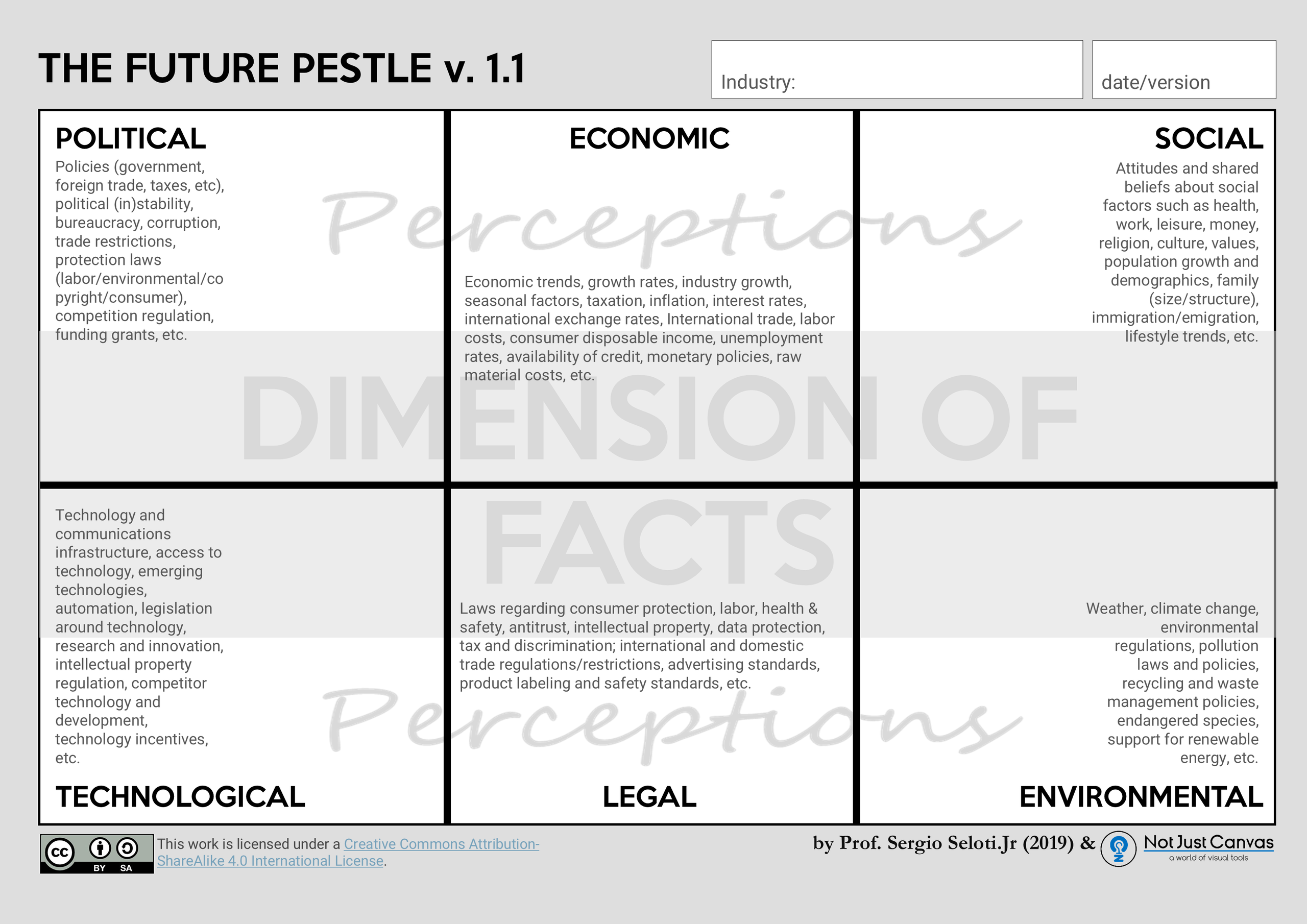
The future is uncertain. But how much of what we believe about it is supported by facts, and how much is simply our perception?
Tool designer: Sergio Seloti.Jr
First publication year: 2019
Version: 1.1
Creative Commons: Attribution-ShareAlike 4.0 International License
Imagine you’re developing a new business strategy: You gather your team, discuss the market, examine some trends, and start talking about what might happen over the next five or ten years. Someone says artificial intelligence will completely transform the industry. Another argues that new regulations will make the business considerably more expensive. Someone else believes customers will become increasingly concerned about sustainability. And, of course, there’s always someone convinced that the economy is heading toward another crisis.
Interesting observations.
But here’s a question:
How much of this is actually supported by evidence, and how much is based on what people believe will happen?
It’s a distinction we don’t always make. And when we’re dealing with the future, it becomes particularly important. After all, the future hasn’t happened yet. So, how can we explore it without treating our expectations as facts?
That’s one of the ideas behind The Future PESTLE.
The problem with predicting the future
Anyone who has worked with strategy is probably familiar with PESTLE analysis.
The framework helps us examine six dimensions of the external environment: Political, Economic, Social, Technological, Legal, and Environmental.
It’s a useful approach: Organizations don’t operate in isolation, and understanding the forces shaping their environment is essential for strategic decision-making. But there’s something that has always bothered me about how environmental analysis is sometimes conducted. We tend to mix different types of information without paying sufficient attention to their nature. An established government policy appears alongside a prediction about future regulation. A documented demographic trend is placed next to someone’s expectation about consumer behavior. An emerging technology is discussed as though widespread adoption were inevitable. Everything goes into the same analysis.
And eventually, we end up with a collection of statements that appear equally credible, even though they may have very different levels of supporting evidence. Now, don’t get me wrong. Perceptions, expectations, and assumptions are not necessarily bad.
In fact, they can be extremely valuable when exploring future possibilities. The problem arises when we fail to distinguish them from facts.
Something being plausible doesn’t make it certain. And something being widely believed doesn’t make it true.
But perceptions can influence decisions, behaviors, and eventually the future itself. Which makes them worth investigating.
From PEST to PESTLE: A Brief History of Environmental Analysis
Before exploring The Future PESTLE, it’s worth looking at where the original framework came from.
And, as is often the case with widely used management tools, its history is a little more complicated than it first appears.
The origins are commonly traced to Francis J. Aguilar, who published Scanning the Business Environment in 1967. His work examined how managers gather information about the external environment, including four broad categories: Economic, Technical, Political, and Social — commonly associated with the acronym ETPS.
Over time, other researchers and practitioners adapted and reorganized these categories.
Arnold Brown, working at the Institute of Life Insurance, is commonly credited with an early adaptation known as STEP. Other variations followed, eventually producing the familiar PEST — Political, Economic, Social, and Technological.
As environmental analysis evolved, additional dimensions became more explicit.
The inclusion of Legal and Environmental factors led to PESTLE and PESTEL, which cover precisely the same six dimensions, simply arranged in a different order.
Other variations, such as STEEP, STEEPLE, and STEEPLED, reorganized or expanded the categories to emphasize ecological, ethical, or demographic considerations.
Interestingly, there is no clearly established single inventor of all these variations. Recent historical research by Richard W. Puyt and Dag Øivind Madsen (2026) even challenges the widespread assumption that Aguilar invented PEST as a standalone analytical framework. Rather, the framework appears to have emerged through decades of contributions from researchers, consultants, educators, and practitioners.
But here’s what I find particularly interesting.
Despite all these variations, most of them address essentially the same question:
Which external factors might influence an organization, industry, or market?
The differences largely concern which dimensions deserve explicit attention.
The Future PESTLE takes a different approach.
Instead of adding another letter to the acronym, it introduces an additional analytical distinction: Facts and Perceptions.
And it uses these two perspectives to support the exploration of alternative future scenarios.
After all, identifying the forces shaping an industry is important.
But understanding what we know about those forces, what we believe might happen, and how different futures could emerge from their interaction is another challenge altogether.
Meet The Future PESTLE
The Future PESTLE is a visual tool designed to support the exploration of external environmental factors and future scenarios through two complementary dimensions: Facts and Perceptions.
It retains the six familiar categories of traditional PESTLE analysis:
- Political
- Economic
- Social
- Technological
- Legal
- Environmental
But it adds another analytical perspective.
Across these categories, the canvas distinguishes a central Dimension of Facts from the surrounding Perceptions areas.
This creates an interesting possibility.
Instead of simply describing what is happening in each environmental dimension, we can explore both what we know and what we believe, expect, or imagine might happen.
And we can use those elements to investigate alternative future scenarios.
The objective is not to predict exactly what the future will look like.
It is to develop a more structured understanding of the forces, uncertainties, and interpretations that may shape it.
Let’s take a closer look.
The Dimension of Facts: What do we actually know?
The central area of the canvas is dedicated to facts.
Here, we should work with information supported by credible evidence.
Established regulations, historical economic indicators, documented demographic changes, observable technological developments, and verified environmental conditions are examples.
Suppose we’re analyzing the future of the automotive industry.
We might investigate government policies on emissions, historical trends in vehicle sales, the evolution of battery technologies, investments in charging infrastructure, and demographic changes affecting mobility.
These observations provide a foundation for understanding the environment.
But we need to be careful.
Knowing that a government has adopted a particular policy is different from knowing how the market will respond to it.
Observing that a technology has improved significantly is not the same as knowing when consumers will adopt it.
And identifying a historical trend does not guarantee that it will continue.
Facts can support our understanding of the future, but they don’t turn future outcomes into facts.
Even a sophisticated forecast remains a forecast.
The purpose of this dimension is to establish what is known, which trends can be documented, and what evidence supports the assumptions used in our analysis.
This creates a more defensible foundation for exploring possible futures.
The Dimension of Perceptions: What do we believe might happen?
Now comes the other dimension: Perceptions.
And this is where things become particularly interesting. People don’t make decisions based exclusively on objective conditions. They also respond to what they believe those conditions mean. Consider two companies operating in the same industry, facing the same economic environment. One believes that an emerging technology represents a serious threat to its existing business model. The other sees the same technology as an opportunity for growth. The technology is the same: the external environment is the same. But their interpretations are different. And these interpretations may lead to completely different strategic decisions. The same happens with consumers, regulators, investors, employees, and other stakeholders. Expectations about the economy may influence investment decisions. Perceptions of technological risks may influence adoption. Beliefs about sustainability may affect consumption patterns. And concerns about future regulation may lead companies to change their strategies before the regulations even exist.
In other words, perceptions can influence reality, even when they are not entirely accurate.
This is why the Future PESTLE explicitly provides room for them.
The idea is not to replace facts with opinions.
Quite the opposite.
It’s to make their differences visible while recognizing that both may play important roles in shaping the future.
Six dimensions, different possible futures
The six PESTLE categories help organize the external forces being investigated.
But when combined with Facts and Perceptions, they can also serve as a framework for scenario exploration.
Political
What policies and political conditions are already established? Which changes are being discussed or anticipated?
How might different political developments affect the industry?
A change in trade policy, for example, may produce different consequences depending on how governments, companies, and investors respond.
Economic
What do current economic indicators tell us? Which trends are supported by historical evidence?
And what do businesses and consumers expect?
The expectation of an economic downturn may influence investment and consumption even before the anticipated downturn materializes.
Social
Which demographic and social changes can be observed?
How might attitudes toward work, consumption, health, education, family structures, and lifestyle evolve?
Some developments may be supported by measurable trends, while others remain uncertain changes in social behavior.
Technological
Which technologies are already available? What developments can be documented?
And which expectations surround their future applications?
Technological feasibility, economic viability, market adoption, and social acceptance are different things.
A technology may exist long before it becomes commercially relevant.
Legal
Which laws and regulations are currently in force?
What legislative changes are being proposed? How do organizations anticipate future compliance requirements?
Here, it is particularly important to distinguish existing legal obligations from possible regulatory developments.
Environmental
Which environmental conditions and trends are supported by scientific evidence?
How might environmental changes, regulations, and stakeholder expectations influence the industry?
Climate-related risks, resource availability, energy transitions, and sustainability expectations may produce very different strategic implications depending on the scenarios considered.
In every category, the objective is to understand both the external conditions and the interpretations surrounding them.
But the most interesting part comes when we start connecting these elements.
From environmental analysis to scenario exploration
Traditional PESTLE analysis can help us describe the environment.
The Future PESTLE encourages us to go further and ask:
What different futures might emerge from these conditions?
This is where scenario analysis becomes particularly useful.
Rather than producing a single prediction, we can explore multiple plausible future configurations.
And the distinction between Facts and Perceptions provides an important basis for doing so.
Let’s imagine we’re investigating the future of higher education.
We begin by examining the factual environment: demographic developments, existing funding arrangements, current regulations, technological capabilities, labor-market indicators, and institutional operating conditions.
Then we explore perceptions.
How do universities interpret technological change?
What do students believe about the value of traditional degrees?
How do employers perceive alternative qualifications?
What do policymakers expect from higher education institutions?
These perceptions may differ substantially among stakeholders.
And their interaction with the factual environment can generate different scenarios.
Consider two illustrative possibilities.
Scenario: Accelerated transformation
In this scenario, technological developments continue to create opportunities for new educational models.
Universities increasingly perceive digital technologies and artificial intelligence as strategic opportunities rather than merely operational tools.
Employers become more receptive to alternative credentials, while students show growing interest in flexible learning pathways.
Institutions respond by experimenting with new educational formats, partnerships, and business models.
This scenario combines observable technological and institutional developments with assumptions about future stakeholder behavior.
Scenario: Constrained transformation
Now imagine a different situation: Technological progress continues, but institutions remain cautious. Concerns about educational quality, regulatory uncertainty, investment costs, and organizational resistance limit the adoption of new approaches. Students and employers continue to place substantial value on established qualifications. Innovation happens, but more slowly and unevenly. Notice something important: both scenarios can begin from the same observed technological conditions.
What changes are the assumptions about stakeholder perceptions, institutional responses, regulatory developments, and interactions between environmental forces. Neither scenario is presented as a prediction. They are alternative representations of how the future might unfold. And that’s the point.
Scenario analysis is not about choosing the future we believe will happen. It is about exploring different futures that could happen and understanding what they might mean.
Facts and Perceptions in scenario analysis
There is an important methodological distinction here: When we develop future scenarios using the Dimension of Facts, we are not claiming that future events are already known. Instead, we use established evidence, verified conditions, and documented trends to establish the foundations and constraints of our scenarios.
The Dimension of Perceptions allows us to explore alternative interpretations, assumptions, expectations, and possible stakeholder responses. Both dimensions contribute to scenario construction. And both can be examined across all six PESTLE categories.
For example, a documented technological development might support several different futures depending on perceptions of its benefits, risks, and economic implications. Similarly, a proposed regulation may generate different organizational responses depending on whether stakeholders expect it to become law.
The resulting scenarios can then be compared.
- Which developments are common to multiple scenarios?
- Which assumptions lead to substantially different outcomes?
- What would need to change for one scenario to become more plausible than another?
- Which early signs might indicate that the environment is moving in a particular direction?
These questions help us move from simply collecting environmental information toward exploring its strategic implications. And, perhaps most importantly, they encourage us to challenge the idea that there is only one plausible future.
How to use The Future PESTLE
I would suggest starting by defining the industry or environment you want to investigate.
The canvas includes a field for the industry, but the approach can also be useful when examining the broader context of a business, an organization, or a strategic initiative.
Next, establish a time horizon.
Are you examining the next three years? Five? Ten?
The appropriate horizon will depend on the industry and the nature of the strategic decisions involved.
A fast-changing digital market may require a different perspective from an infrastructure-intensive industry.
Then, begin populating the Dimension of Facts.
Identify relevant developments across the six PESTLE categories.
Use credible sources, distinguish established conditions from forecasts, and avoid treating unsupported assumptions as objective information.
Afterward, turn your attention to Perceptions.
What do different stakeholders believe will happen?
Which developments are considered opportunities or threats?
Where do expectations diverge?
Which assumptions about the future are influencing present decisions?
At this stage, it can be useful to involve people with different backgrounds and perspectives.
A technological specialist, a financial analyst, a policymaker, and a customer may interpret the same developments very differently.
These differences should not automatically be treated as disagreements to resolve.
They may reveal important uncertainties worth investigating.
Once the canvas contains a meaningful collection of facts and perceptions, look for relationships across the categories.
How might a political development influence economic conditions?
Could technological progress accelerate social change?
Might environmental pressures create new legal requirements?
Could changing social expectations influence business models or regulatory decisions?
From these relationships, begin constructing alternative scenarios.
For each scenario, identify the factual foundations, the important assumptions, and the possible interactions that could produce that future.
You don’t need dozens of scenarios.
A small set of sufficiently distinct, internally coherent, and plausible alternatives can be far more useful than a long list of loosely connected predictions.
Finally, discuss their implications.
What opportunities and risks might arise?
Which strategic decisions would remain appropriate across several scenarios?
Which investments or commitments might become problematic under particular conditions?
What developments should be monitored over time?
The Future PESTLE is not intended to answer all these questions automatically.
But it can provide a shared visual foundation for exploring them.
A workshop tool, not a crystal ball
The Future PESTLE can be used individually, but collaborative workshops are particularly interesting.
One of the greatest challenges of future-oriented discussions is that participants often bring very different interpretations of the same environment.
Someone may be highly optimistic about technological developments.
Another may be concerned about regulation.
A third may consider economic constraints far more important than either.
Without a structured approach, these discussions can easily become exchanges of opinions.
And the loudest or most senior voice may end up defining the future for everyone else.
A visual framework helps make these interpretations explicit.
Participants can contribute evidence, assumptions, expectations, and possible developments.
They can question one another’s reasoning and identify where additional information is necessary.
Rather than forcing immediate agreement, the group can explore alternative scenarios and examine what each would imply.
This does not eliminate bias, uncertainty, or the limitations of available information.
But it makes the reasoning more transparent.
And that, in strategic discussions, is already a significant improvement.
Last, but not least
There is something fascinating about the future.
We spend considerable time discussing it, planning for it, worrying about it, and sometimes acting as if we already know what will happen.
But we don’t.
The future is shaped by a complex interaction of political, economic, social, technological, legal, and environmental forces.
Some developments can be observed and measured.
Others remain uncertain.
And people’s perceptions of those developments can influence the decisions that help shape what eventually happens.
This is why I believe separating facts from perceptions is particularly useful when exploring future scenarios.
It encourages us to distinguish evidence from interpretation without dismissing the importance of either.
And it reminds us that a plausible future is not necessarily a probable one, much less an inevitable one.
The Future PESTLE is not intended to replace sophisticated forecasting techniques or comprehensive scenario-planning methodologies.
It offers something different: a relatively simple visual structure to organize external environmental analysis, expose assumptions, and explore alternative futures.
The objective is not to predict the future with certainty, but to become better prepared for a future that remains uncertain.
And perhaps that is a much more realistic ambition.
To download The Future PESTLE
You can use The Future PESTLE v1.1, developed by Prof. Sergio Seloti.Jr (2019), to support environmental analysis, strategic planning, scenario exploration, and innovation workshops.
Use it to examine the six PESTLE dimensions through both facts and perceptions, develop alternative future scenarios, and explore their implications for your industry or organization.
The Future PESTLE is available under a Creative Commons Attribution-ShareAlike 4.0 International License.
Not Just Canvas — a world of visual tools.
Leave a Reply