
What if designing an academic course was more than deciding what to teach?
Tool designer: Prof. Sergio Seloti.Jr
First publication year: 2022
Version: 1.0
Let’s imagine a familiar situation.
A university is developing a new academic program. After months of discussions, the curriculum is finally approved. The program has a name, a list of courses, a credit structure, and perhaps even an impressive collection of learning outcomes.
Everything looks good.
Now comes the interesting part.
Different lecturers are invited to develop their courses. Each receives a course title, a few general guidelines, and perhaps a template for the course description.
And off they go.
One lecturer prepares an extensive collection of lectures. Another develops an ambitious project-based learning experience. Someone else decides to assess students through a written examination. And another designs a course around a complex group assignment.
Individually, these might all be excellent courses.
But what happens when we put them together?
Are the students developing the knowledge, skills, and attitudes expected from the program? Do the courses complement one another? Are we teaching what we intend to assess? Are we assessing what students were actually expected to learn?
Or are we simply assembling a collection of courses and calling it a curriculum?
These are some of the questions behind The Course Description Canvas.
A course is more than a collection of topics
When designing a course, it is tempting to begin with content.
After all, we are subject-matter experts. We know our disciplines, have our favorite theories and frameworks, and probably have a good idea of what students should learn.
So, we start listing topics.
Then we distribute those topics across the available weeks, decide how many lectures we need, prepare some assignments, and eventually write the learning outcomes.
Does that sound familiar?
There is nothing inherently wrong with starting from content. The problem arises when content becomes the main driver of every other decision.
Because teaching something is not the same as ensuring that students learn it.
And learning something is not necessarily the same as being able to apply it in a professional context.
A student might know several strategic management frameworks without being capable of analyzing a real strategic problem.
Another might understand project management concepts without being able to coordinate an actual project.
In both cases, knowledge exists, but something important is missing.
A well-designed academic course should bring together what students need to know, what they should be capable of doing, and how they are expected to approach professional situations.
This requires more than a list of topics.
It requires a coherent educational design.
Meet the Course Description Canvas
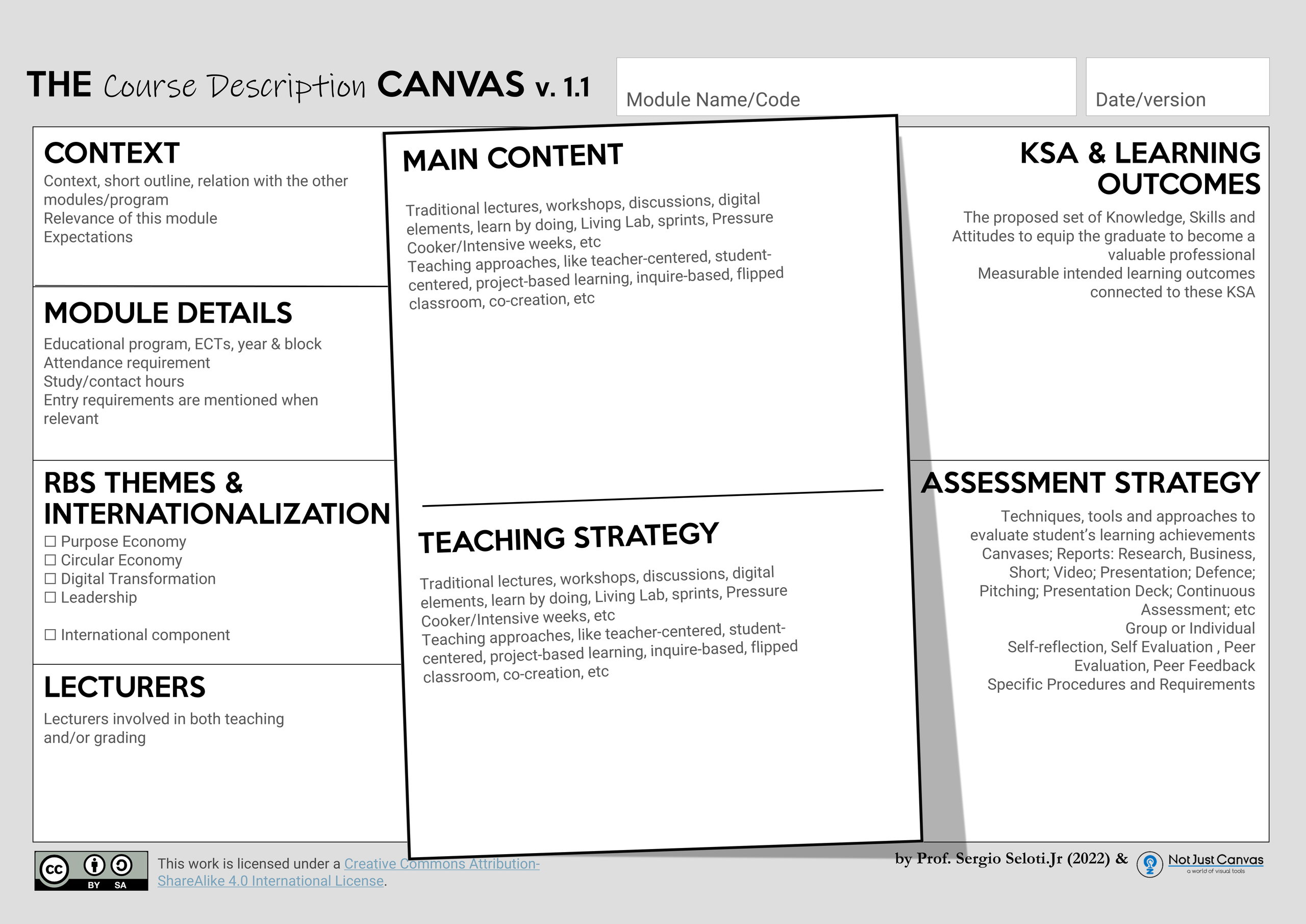
The Course Description Canvas is a visual tool developed to support the design and redesign of academic courses and modules.
It organizes the essential elements of a course into interconnected areas, allowing educators to see the whole design instead of working with disconnected sections of a traditional course description document.
The canvas addresses:
- Context
- Module Details
- Main Content
- Teaching Strategy
- KSA & Learning Outcomes
- Assessment Strategy
- Institutional Themes & Internationalization
- Lecturers
Each area addresses a different aspect of course design.
But the real value of the canvas comes from the relationships between them.
A course may have excellent content, engaging teaching activities, and sophisticated assessments. Yet, if these elements don’t support the same learning objectives, something is wrong.
The Course Description Canvas helps make those inconsistencies visible before they become problems for students and lecturers.
Let’s take a closer look.
Context: Why does this course exist?
Before deciding what to teach, we should understand why the course belongs in the program.
What is its relevance? How does it relate to other modules? What role does it play in the student’s educational journey?
Imagine a master’s program in consultancy and entrepreneurship.
A course on strategic analysis might be intended to provide students with the analytical foundations required for more advanced consulting projects.
In that case, its role goes beyond introducing strategy frameworks. It needs to prepare students for what comes next.
And that changes how we approach the course.
Perhaps some concepts have already been introduced in previous modules. Perhaps certain capabilities will be developed further in subsequent courses.
Understanding these relationships helps us avoid unnecessary repetition, identify gaps, and establish appropriate expectations.
A course should not be designed as an isolated island within a curriculum.
Even when the Course Description Canvas is used independently, understanding the surrounding educational context makes the resulting design considerably stronger.
KSA & Learning Outcomes
This is one of the most important areas of the canvas.
KSA stands for Knowledge, Skills, and Attitudes.
These three dimensions help us describe what students need to develop as they prepare for their future professional roles.
Knowledge concerns what students need to understand.
Skills concern what they should be capable of doing.
Attitudes concern how they approach situations, responsibilities, challenges, and interactions.
Consider, for example, a course in business consultancy.
Students might need knowledge of strategic analysis frameworks, skills in structuring ambiguous business problems, and attitudes such as intellectual honesty, critical thinking, and professional responsibility.
These elements are related, but they are not interchangeable.
Knowing how a consulting framework works does not necessarily mean being able to use it appropriately.
And knowing how to use it does not automatically mean exercising sound professional judgment.
The challenge for the educator is to translate the desired KSAs into measurable intended learning outcomes.
What should students demonstrate by the end of the course?
Instead of simply stating that students will understand strategic analysis, we might expect them to analyze a complex business situation, identify its relevant strategic challenges, and develop evidence-based recommendations.
The difference is important.
The second formulation gives us a clearer indication of what students should be capable of demonstrating.
And that leads to another question:
How will we know whether they have actually achieved it?
Main Content: What do students need to learn?
Once the intended learning outcomes become clear, we can examine the content necessary to support them.
Which theories, concepts, frameworks, tools, and subject areas should be included?
More importantly, which are truly necessary?
One of the difficulties in designing academic courses is that there is almost always more content available than time to teach it.
For subject-matter experts, deciding what to leave out can be particularly challenging.
Everything seems important.
But a course is not supposed to contain everything we know about a subject.
It should provide the knowledge and learning experiences necessary to achieve its educational objectives.
Returning to our consultancy example, perhaps students need to understand strategic diagnosis, industry analysis, stakeholder analysis, and problem structuring.
But how deeply should each subject be addressed?
Should students merely recognize the concepts? Compare different approaches? Apply them to unfamiliar situations? Critically evaluate their limitations?
The answers depend on the expected learning outcomes and the role of the course within the program.
Content selection should be intentional, not simply encyclopedic.
Teaching Strategy: How will learning happen?
Now we arrive at another important distinction.
What we teach is not the same as how we teach it.
The Teaching Strategy area invites educators to consider the learning experiences they intend to create.
Traditional lectures, workshops, discussions, project-based learning, inquiry-based learning, flipped classrooms, living labs, co-creation activities, and other approaches may all have a place.
But they should serve a purpose.
Suppose our students are expected to develop the ability to structure complex business problems.
Would a series of lectures explaining different problem-solving techniques be sufficient?
Probably not.
Lectures might help students understand the concepts, but applying those concepts to ambiguous situations requires practice.
Perhaps students should work with real or simulated consulting briefs, develop issue trees, challenge assumptions, and defend their reasoning.
In this case, workshops and problem-based activities might provide better opportunities to develop the intended capabilities.
This does not mean that traditional lectures are inherently inferior or that every course needs to adopt the latest educational trend.
Different strategies serve different purposes.
The question is not which teaching approach is fashionable, but which one is appropriate for the learning we want to achieve.
And, of course, practical constraints such as class size, available resources, contact hours, and student characteristics also matter.
Assessment Strategy: Are we assessing what matters?
Here is a situation that deserves some reflection.
Imagine a course whose learning outcomes emphasize collaboration, critical thinking, and the ability to solve complex problems.
Students spend weeks participating in workshops, developing projects, and working in teams.
But at the end of the course, their achievement is evaluated exclusively through a multiple-choice examination focused on memorizing concepts.
Something doesn’t quite fit, does it?
The Assessment Strategy area encourages us to design assessments that are coherent with the intended learning outcomes and the teaching strategy.
Depending on the course, students might demonstrate their achievements through research reports, business reports, presentations, videos, pitches, practical assignments, or other forms of assessment.
Individual and group assessments may serve different objectives.
Peer feedback, self-evaluation, reflection, and continuous assessment may also play important roles.
However, none of these approaches is automatically better than the others.
For example, a group consulting project may be appropriate for assessing collaborative problem-solving, but it might not provide sufficient evidence of every student’s individual analytical capabilities.
An individual defense or reflection component could help address that limitation.
The important point is to think carefully about what evidence of learning an assessment is expected to produce.
Assessment should not be something added after the course has already been designed.
It is part of the design itself.
Module Details, Institutional Themes, and Lecturers
Of course, course design does not happen in a vacuum.
There are institutional requirements, organizational constraints, and practical considerations.
The Module Details area addresses elements such as the educational program, ECTS credits, academic year and block, attendance requirements, study and contact hours, and relevant entry requirements.
These may appear primarily administrative, but they can significantly influence the feasibility of the proposed educational design.
An ambitious learning experience requiring extensive practical activities may be difficult to implement within a module with limited contact hours.
Similarly, the Institutional Themes & Internationalization area encourages educators to connect their courses with broader educational priorities.
The original version of the Course Description Canvas, developed in the context of Rotterdam Business School, includes themes such as Purpose Economy, Circular Economy, Digital Transformation, Leadership, and an international component.
These particular themes reflect that institutional context. Other educational institutions can adapt this area to their own strategic priorities, graduate attributes, or curriculum requirements.
Finally, the Lecturers area identifies those responsible for teaching and assessment.
This is especially relevant when several educators are involved in delivering a module.
A shared understanding of the course design helps maintain coherence across different classes, teaching activities, and assessment responsibilities.
From Course Design to Program Architecture
So far, we’ve discussed the Course Description Canvas as an independent tool.
And it certainly can be used that way.
Whether you’re creating a new course, redesigning an existing module, or discussing improvements with colleagues, the canvas provides a practical way to organize the necessary decisions.
But there is another possibility.
What if, instead of designing courses individually and then assembling them into a program, we started with the professional we want our students to become?
This is where the Course Description Canvas becomes part of something larger.
The NJC Program Architecture is a suite of complementary visual tools developed to support the design and redesign of academic and educational programs.
The suite brings together four elements:
The Graduate Profile Canvas
What kind of graduate is the program intended to develop?
What professional profile, capabilities, and characteristics should students have when they complete their studies?
The Graduate Profile Canvas helps establish this broader destination.
The KSA Cards — Knowledge, Skills & Attitude
Once we have a clearer understanding of the intended graduate profile, we need to explore the knowledge, skills, and attitudes that will support it.
The KSA Cards provide a complementary way to structure and discuss these dimensions.
The Course Description Canvas
Now we can examine how individual courses and modules contribute to developing those capabilities.
Which KSAs will each module address? What learning outcomes should be achieved? Which content, teaching strategies, and assessments will support them?
The Program Architecture Blueprint
Finally, the Program Architecture Blueprint provides an aggregating framework for bringing these elements together at the program level.
Instead of considering each module separately, the program can be examined as an interconnected educational architecture.
This opens the door to a different kind of curriculum discussion.
Are important capabilities missing? Are some unnecessarily repeated? Is there an appropriate progression in complexity and expected achievement? Do the individual courses contribute to the intended graduate profile?
These are questions that are difficult to answer when looking at course descriptions one at a time.
But they become much easier to discuss when the different elements of the curriculum are made visible and connected.
The Course Description Canvas is therefore useful on its own, but it can also contribute to a more systematic approach to program design.
And that is precisely the purpose of having a suite of complementary tools rather than a single, oversized canvas trying to address everything.
Using the Course Description Canvas in practice
One way to start is to bring together the lecturers and coordinators involved in developing or reviewing a module.
Rather than immediately opening the existing course description document, begin by discussing its purpose.
Why does this module exist? What should students be capable of demonstrating after completing it? Which knowledge, skills, and attitudes should it develop?
Then examine the content, teaching strategies, and assessment approaches.
Look for inconsistencies.
Does the proposed teaching strategy provide opportunities to develop the expected capabilities?
Will the assessments produce appropriate evidence that students have achieved the learning outcomes?
Are the expectations realistic given the available time and resources?
You may discover that the course is already well aligned.
Or perhaps you will realize that some activities contribute little to the intended outcomes, that assessments need to be reconsidered, or that important capabilities are insufficiently addressed.
This is not necessarily a problem with the lecturer or the course.
It is simply part of the design process.
The canvas can also be used to compare alternative designs, facilitate discussions between educators, and document decisions before preparing the formal course description.
When working at the program level, the Graduate Profile Canvas, KSA Cards, and Program Architecture Blueprint can provide additional context for those discussions.
The essential principle remains the same: make educational design decisions explicit, visible, and open to discussion.
Last, but not least
A course description is often treated as a document that needs to be completed, approved, and eventually filed somewhere in an institutional system.
And, to be fair, it does serve an important administrative purpose.
But I believe we can do more with it.
A course description can also represent the result of a thoughtful educational design process.
One in which content is selected for a reason, teaching strategies support the intended learning, assessments generate meaningful evidence of achievement, and individual courses contribute to a coherent educational program.
The Course Description Canvas was developed to help make that process more visible and manageable.
It won’t replace the expertise of educators, the principles of curriculum design, or the complex decisions involved in developing academic programs.
Nor should it.
What it can do is provide a common visual language for discussing those decisions.
And when used together with the other tools in The NJC Program Architecture, it can help connect the design of individual courses to a much bigger question:
Are we simply teaching a collection of subjects, or are we deliberately developing the professionals we intend to graduate?
I think that’s a question worth asking.
Download The Course Description Canvas
Explore The Course Description Canvas v1.1, developed by Prof. Sergio Seloti.Jr (2022), and use it to design or redesign your next academic course or module.
The canvas can be used independently or in combination with the KSA Cards, The Graduate Profile Canvas, and The Program Architecture Blueprint as part of The NJC Program Architecture suite.
The Course Description Canvas is licensed under a Creative Commons Attribution-ShareAlike 4.0 International License.
Not Just Canvas — a world of visual tools.
Leave a Reply